




The cable machine is one of the most underutilized tools in the gym.
Not because it lacks potential, but because most lifters don’t understand how to use it effectively.
It’s not just about pulling handles. The gym cable attachments you clip on determine your grip, your angle, and the muscle group you’re actually training.
Swap the bar, and you change the lift entirely.
Whether you’re building size, chasing symmetry, or just want to stop wasting reps, knowing the difference between a tricep rope and a V-bar isn’t optional. It’s essential.
What Are Cable Attachments and Why Do They Matter?
Cable attachments are the interchangeable handles, bars, ropes, and grips you connect to a cable pulley machine. They might look like small accessories, but they control everything from range of motion to muscle activation patterns.
Choosing the right attachment can mean the difference between targeting your lats or your traps, your long head of the triceps or your lateral delts.
It’s not just about variety. It’s about intent.
Every attachment changes the:
- Grip position (pronated, neutral, supinated)
- Grip width (close, standard, wide)
- Angle of pull (horizontal, vertical, diagonal)
- Stability demand (fixed vs. rotating)
According to a 2024 review in the Journal of Functional Morphology and Kinesiology, resistance training with cables and adjustable grip angles produced higher levels of muscle activation in isolation exercises compared to free weights, especially in the biceps, deltoids, and triceps.
In short: Your attachment choice directly impacts your results. If you want to stop guessing and start training with purpose, you need to know which tool does what.
Key Benefits of Using Cable Attachments in Your Training
The right cable attachment doesn’t just make an exercise more comfortable. It makes it more effective.
Whether you’re chasing size, strength, or joint longevity, cables offer benefits that barbells and dumbbells simply can’t replicate.
Target Muscles From Multiple Angles
Cable machines allow you to work muscles through a full range of motion with constant tension, something free weights can’t always deliver. By switching attachments, you adjust not just the grip, but the direction and type of resistance.
This is especially valuable for lagging muscle groups or correcting imbalances. For example:
- Use a rope to emphasize the long head of the triceps.
- Switch to single D-handles to isolate one lat at a time.
- Add a V-bar to hammer the mid-back in a neutral grip.
Improved Range of Motion
Fixed bars and machines often restrict your natural range. Cable attachments, on the other hand, allow you to move freely, adjusting your angle of pull and wrist position in real time.
This means:
- Deeper stretches in flyes and rows
- Greater peak contractions in biceps curls or triceps pushdowns
- Fuller ROM in single-arm movements like lat pulldowns
And that leads to better results, especially for hypertrophy.
Reduced Joint Stress
Because cables offer smooth, consistent resistance and allow for natural wrist and elbow movement, they’re gentler on your joints, particularly the shoulders, elbows, and wrists.
That makes cable attachments ideal for:
- Lifters recovering from joint injuries
- High-volume training blocks
- Aging athletes who want intensity without inflammation
A 2023 clinical review in Sports Health noted that cable-based resistance training showed lower joint torque loads compared to barbell training, making it a recommended tool in both rehab and active aging protocols.
Great for Beginners and Advanced Lifters Alike
Cable attachments offer adjustability and control, perfect for beginners learning form, and advanced lifters refining muscle tension.
- New lifters can learn to “feel” the target muscle with better control.
- Seasoned lifters can create constant tension drop sets, supersets, and isolation finisher work with maximum muscle engagement.
Whether you’re new to the gym or deep into programming cycles, cable attachments scale with you.
The Most Popular Gym Cable Attachments (Explained)
Each cable attachment changes the mechanics of the exercise, targeting muscles differently based on grip, range, and tension. Here’s a breakdown of the most widely used attachments, how they work, and when to use them.
Tricep Rope
- Use For: Triceps pushdowns, overhead extensions, face pulls, rope hammer curls
- Muscles Worked: Triceps (long head), rear delts, traps
- Why It’s Great: The flexible grip allows you to pull the rope apart at the bottom, increasing contraction and reducing wrist strain.
Straight Bar
- Use For: Biceps curls, triceps pushdowns, upright rows
- Muscles Worked: Biceps, triceps, delts
- Why It’s Great: Offers a rigid grip for strict control. Ideal for lifters who want consistent wrist positioning during heavy cable movements.
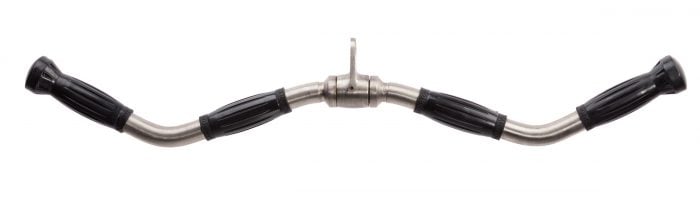
EZ Curl Bar (Angled Bar)
- Use For: Cable curls, triceps pressdowns, rows
- Muscles Worked: Biceps (brachialis emphasis), triceps
- Why It’s Great: Angled grip reduces elbow strain while allowing a strong contraction, especially good for high-rep arm work.
Lat Pulldown Bar (Wide Grip Bar)
- Use For: Wide grip pulldowns, seated rows, straight-arm pushdowns
- Muscles Worked: Lats, rhomboids, teres major
- Why It’s Great: Helps build width in the back with a longer range of motion and a stronger stretch.
V-Bar (Close Grip Row Handle)
- Use For: Seated rows, close grip pulldowns, triceps pressdowns
- Muscles Worked: Mid-back, biceps, triceps
- Why It’s Great: Neutral grip and compact design increase elbow flexion and contraction in the short range.
D-Handles (Single Grips)
- Use For: One-arm rows, cable flyes, lateral raises
- Muscles Worked: Chest, lats, shoulders, arms
- Why It’s Great: Perfect for unilateral work. Allows full rotation and personalized angles for isolation movements.
Ankle Strap
- Use For: Glute kickbacks, leg raises, hip abductions
- Muscles Worked: Glutes, hamstrings, hip flexors
- Why It’s Great: Adds targeted lower-body work to your training—great for posterior chain development and rehab.
Cable Attachment Comparison Table
| Attachment | Primary Use | Muscles Worked | Best For |
| Tricep Rope | Pushdowns, overhead extensions, face pulls | Triceps, rear delts, traps | Isolation + flexible grip |
| Straight Bar | Curls, pressdowns, upright rows | Biceps, triceps, delts | Strict movement + control |
| EZ Curl Bar | Curls, rows, pressdowns | Biceps, triceps | Ergonomic grip + reduced joint stress |
| Lat Pulldown Bar | Pulldowns, rows, straight-arm pushdowns | Lats, upper back | Back width + full ROM |
| V-Bar | Close grip rows, pressdowns | Mid-back, arms | Short range power + elbow flexion |
| D-Handles | One-arm rows, flyes, raises | Chest, lats, shoulders | Unilateral isolation + freedom |
| Ankle Strap | Kickbacks, abductions, leg raises | Glutes, hamstrings, hips | Lower body cable work + rehab |
Hampton Tip: Want a smoother feel and longer equipment life? Look for cable attachments with chrome plating, rubberized grips, and steel swivel connectors for full rotation under load.
How to Choose the Right Cable Attachment (Based on Your Goal)
There’s no one-size-fits-all when it comes to cable attachments. The best tool depends on what you’re training for. Whether it’s muscle growth, raw strength, joint-friendly movement, or functional fitness.
Here’s how to choose the right attachment for your specific goal.
For Muscle Growth (Hypertrophy)
To maximize hypertrophy, you want:
- Constant tension
- Full range of motion
- High-volume training potential
Recommended attachments:
- Tricep Rope – Allows deeper contraction and full extension
- D-Handles – Perfect for unilateral flyes, curls, and rows
- EZ Curl Bar – Comfortable grip for long arm supersets
Why it works: These attachments let you isolate muscles through a long range of motion with minimal joint stress, perfect for bodybuilding-style training.
For Strength Training
Strength work is about efficiency and load control. Attachments should support strict, heavy movement with maximum stability.
Recommended attachments:
- Straight Bar – For heavy pressdowns and curls
- V-Bar – For compact, neutral grip rows and pulldowns
- Lat Pulldown Bar – Ideal for wide, controlled back work
Why it works: These attachments minimize momentum and force strict form, essential for progressive overload and compound strength.
For Functional Fitness and Athletic Training
Functional training emphasizes multi-planar movement, core engagement, and fluid transitions between exercises.
Recommended attachments:
- Nylon Tricep Rope – Great for face pulls and rotational work
- D-Handles – Excellent for one-arm presses and rows
- Ankle Strap – Enables glute and hip mobility work
Why it works: These tools offer a full range of motion, allow unilateral work, and support dynamic, sport-specific patterns.
For Injury Prevention or Rehab
If you’re recovering from an injury or looking to train joint-friendly, choose attachments that allow neutral grip angles and controlled motion.
Recommended attachments:
- EZ Curl Bar – Reduces wrist and elbow stress
- D-Handles – Natural wrist alignment and lighter loads
- Ankle Strap – For isolated glute and hamstring activation
Why it works: These attachments provide support without forcing fixed bar paths or exaggerated joint positions, ideal for recovery and prehab.
Hampton Tip: The more specialized your training, the more specialized your attachments should be. It’s not about using more equipment. It’s about using the right equipment.
Recommended products


How Different Attachments Change the Exercise
Cable machines allow precise muscle targeting, but only if you’re using the right tool. The attachment you clip on doesn’t just change how it feels. It changes which muscle gets hit the hardest, how your joints move, and how much range of motion you can achieve.
Even small swaps can have a major impact.
Tricep Rope vs. Straight Bar Pushdowns
- Tricep Rope
- Promotes external rotation at the bottom of the rep
- Allows greater long head activation
- Easier on the wrists and elbows
- Encourages full extension
- Promotes external rotation at the bottom of the rep
- Straight Bar
- Locks hands in a pronated position
- Great for strict, heavy pressdowns
- Shorter range of motion
- Can stress wrists at certain angles
- Locks hands in a pronated position
Takeaway: Rope = more natural movement, better stretch and contraction. Straight bar = more rigid, stricter loading.
D-Handle Rows vs. Lat Bar Rows
- D-Handles
- Enables unilateral control
- Can adjust torso angle and range
- Better for identifying imbalances
- Adds core engagement and stabilizer work
- Enables unilateral control
- Lat Bar (Wide Grip)
- Promotes bilateral symmetry
- Ideal for mass-building in the upper back
- Less core involvement
- Limits individual arm adjustment
- Promotes bilateral symmetry
Takeaway: D-handles = more control and isolation. Lat bar = more stability and overload.
V-Bar vs. EZ Curl Bar for Biceps and Triceps
- V-Bar
- Neutral grip hits brachialis and forearms
- Compact and great for close-grip pressdowns or curls
- Helps reduce shoulder stress in rows
- Neutral grip hits brachialis and forearms
- EZ Curl Bar
- Angled grip hits both heads of the biceps
- Comfortable for high-rep triceps work
- Ergonomic and joint-friendly
- Angled grip hits both heads of the biceps
Takeaway: V-bar = strong short-range work. EZ curl bar = versatile and volume-friendly.
Attachment vs. Muscle Emphasis Chart
| Attachment | Primary Emphasis | Secondary Emphasis | Best For |
| Tricep Rope | Long head of triceps | Rear delts, core | Hypertrophy, range of motion |
| Straight Bar | Lateral triceps | Forearms | Strength, strict control |
| D-Handles | Lats (unilateral) | Core, rear delts | Isolation, symmetry work |
| Lat Bar | Upper/mid lats | Rhomboids, teres major | Mass-building, pull strength |
| EZ Curl Bar | Biceps, triceps | Brachialis | Volume sets, joint comfort |
| V-Bar | Brachialis, triceps | Forearms | Heavy close-grip work |
Hampton Tip: Don’t just swap attachments randomly. Match the grip and angle to your intent. One inch of wrist rotation can shift tension to a completely different head of the muscle.
Expert Tips for Using Cable Attachments Effectively
Cable machines are precise tools, but only if you use them with precision. No matter which attachment you’re working with, these strategies will help you lift smarter, not just heavier.
H3: Control the Concentric and the Eccentric
Letting the weight stack slam back into place wastes the most effective half of your rep. Cables provide constant resistance so use it.
- Lift with intent (1–2 seconds up)
- Lower with control (2–3 seconds down)
- Pause briefly at peak contraction
This builds more time under tension and eliminates momentum.
Keep Your Grip Intentional, Not Just Comfortable
Every handle forces your wrist and elbow into a specific path. Grip isn’t just about feel. It’s about targeting.
- Neutral grip (palms facing each other): More elbow flexion, joint-friendly
- Supinated grip (palms up): More biceps or lat engagement
- Pronated grip (palms down): Emphasizes triceps and rear delts
Quick Fix: If an attachment feels awkward, try adjusting wrist angle slightly; it could unlock a better muscle connection.
Don’t Chase Weight. Chase Tension
With cables, it’s easy to overload and lose form. But you’re not just moving the stack. You’re fighting angle, tension, and alignment.
- Use a weight that allows full range of motion
- Maintain tension throughout the movement, especially at the stretch
- Focus on the muscle, not the movement
Reminder: Form breakdown = tension loss = wasted reps.
Match the Attachment to the Exercise
Some exercises demand freedom of movement, others need fixed stability. Choose accordingly.
- Use ropes or D-handles for flyes, face pulls, and presses
- Use bars for curls, rows, and heavy triceps work
- Use ankle straps for glutes, hamstrings, and lower body isolation
Clean Attachments = Better Grip and Longevity
If you’re training in a shared or commercial gym:
- Wipe grips after use
- Check for frayed cables or cracked rubber ends
- Avoid yanking attachments to re-rack; respect your equipment
At home? Store your attachments dry and hang them between sessions to prevent warping or rust.
Hampton Tip: The best attachment in the world won’t fix a lazy rep. Focus on connection, not just completion.
Cable Attachment Maintenance & Safety Tips
Whether you train at home or manage a full commercial setup, keeping your cable attachments in top shape ensures better performance, longer lifespan, and safer lifts.
Here’s how to protect your gear and your training.
✔ Inspect Before You Train
- Check for frayed cables, loose bolts, or cracked rubber ends
- Test the swivel joint for smooth rotation
- Look for any sharp edges or rusted spots
Never ignore small damage, especially on rotating parts. Failure under load = injury waiting to happen.
✔ Clean Grips Regularly
- Wipe down rubber, chrome, or nylon grips after use
- Use mild disinfectant or alcohol wipes to prevent buildup
- Avoid corrosive cleaners; stick to gym-safe products
Clean gear = better grip and better hygiene.
✔ Store Attachments Properly
- Hang handles and bars to avoid warping
- Avoid leaving attachments on the floor or exposed to moisture
- Keep nylon ropes or ankle straps out of direct sunlight to prevent material breakdown
✔ Use Proper Clips and Carabiners
- Only use locking, rated carabiners for attachment points
- Check clips regularly for signs of bending or rust
- Never overload with DIY solutions; your gear isn’t the place to cut corners
✔ Replace Worn Gear
If the attachment:
- Slips during movement
- Feels unstable under tension
- Has exposed metal or torn grip material
…it’s time to upgrade.
Better equipment = better results. Don’t train with compromised tools.
Final Thoughts: Cable Attachments Are a Small Detail That Deliver Big Results
Training smarter isn’t about doing more. It’s about doing what matters. Cable attachments are one of the most overlooked tools for building real strength, size, and control.
They give you range of motion, constant tension, and targeted muscle activation you can’t always get with free weights or machines. When you know what each attachment does (and how to use it), you stop guessing and start growing.
Whether you’re fine-tuning lagging muscles, rehabbing an injury, or going after serious numbers, the right attachment makes the rep count.
Ready to upgrade your setup?
Explore commercial-grade cable attachments built to handle real training at Hampton Fitness.